
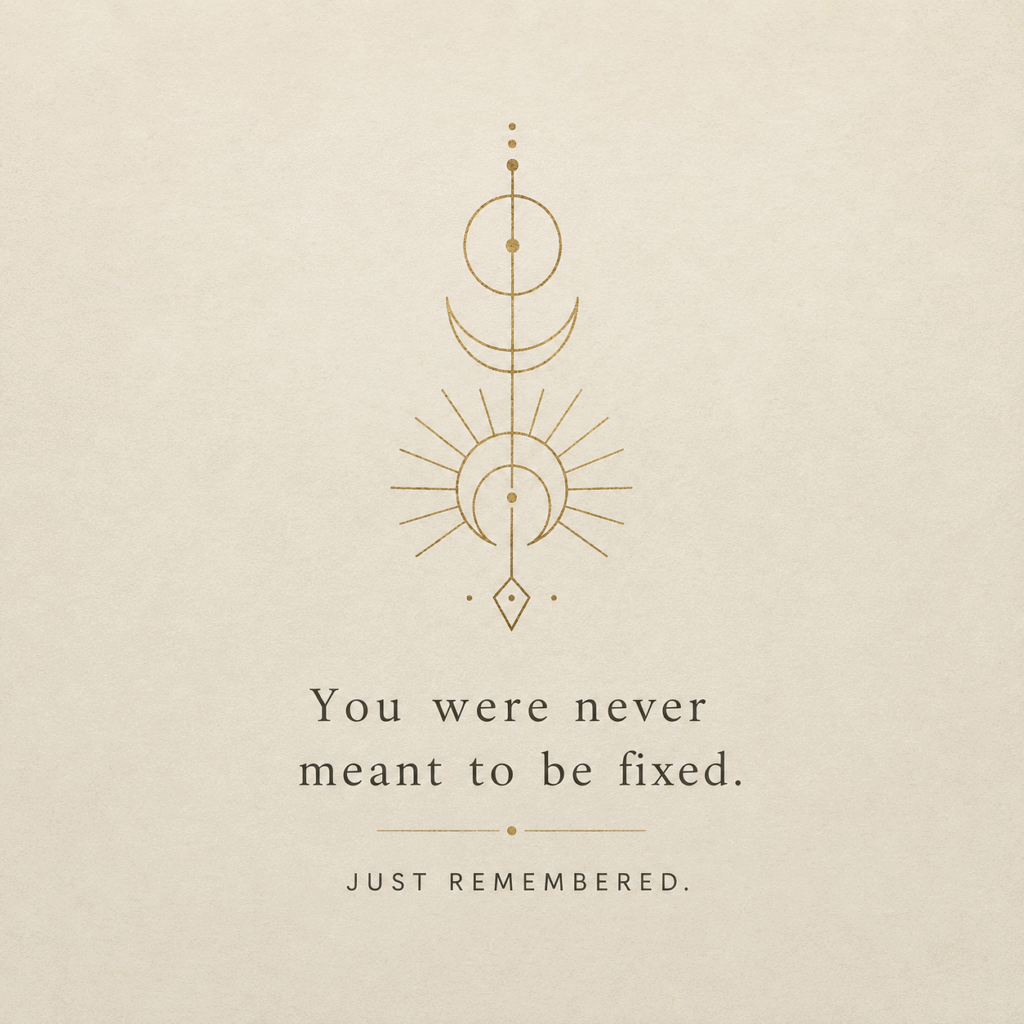
What If You Were Never Broken to Begin With
If you’ve searched how to fix yourself, there’s a good chance you’re carrying something heavy.
Maybe you’re emotionally exhausted. Maybe you’ve been through heartbreak, burnout, anxiety, grief, or years of trying to be everything for everyone else. Perhaps you’ve spent countless hours reading self-help books, listening to podcasts, or watching videos that promise to transform your life.
The desire to heal is deeply human. But somewhere along the way, many of us have absorbed the idea that healing means becoming someone different—that before we can experience peace, we must somehow repair what is “wrong” with us.
What if that isn’t true?
What if the journey isn’t about fixing a broken person but about reconnecting with the person who has always been there beneath the stress, fear, and self-doubt?
This article offers a different perspective. Not one that dismisses your pain, but one that invites you to see yourself with greater compassion.
Why Do So Many People Search How to Fix Yourself?
It’s understandable why so many people search how to fix yourself.
We live in a culture that constantly encourages improvement. Be more productive. Be more confident. Be happier. Sleep better. Eat better. Think more positively. Achieve more.
While personal growth can be valuable, it can also create the quiet belief that we are never enough as we are.
Social media often amplifies this message. We compare our behind-the-scenes struggles to everyone else’s carefully edited highlights. We begin believing that everyone else has figured life out while we’re somehow falling behind.
When life feels overwhelming, it’s easy to conclude that we must be the problem.
But many of the struggles people experience are natural responses to difficult circumstances.
Someone recovering from loss isn’t broken.
Someone living with chronic stress isn’t broken.
Someone carrying years of emotional pain isn’t broken.
They are responding to experiences that have shaped them.
Recognising this difference changes everything.
How to Fix Yourself Starts by Changing the Question
Instead of asking, “What’s wrong with me?”
Try asking:
“What has happened to me?”
“What have I been carrying?”
“What do I need right now?”
These questions move us away from shame and toward understanding.
Imagine a plant that has been left without sunlight or water for weeks.
You wouldn’t call the plant broken.
You would change its environment.
Human beings are remarkably similar.
Sometimes what appears to be a personal failure is actually the result of prolonged stress, loneliness, unrealistic expectations, lack of rest, or emotional wounds that have never had space to heal.
Changing the question doesn’t magically solve life’s challenges, but it creates room for self-compassion.
That compassion often becomes the foundation from which meaningful change grows.
Your Nervous System May Be Asking for Safety, Not Perfection
Many people spend years trying to think their way out of emotional pain.
But our bodies often carry experiences that our minds struggle to explain.
After prolonged stress, conflict, uncertainty, or emotional overwhelm, the nervous system can remain on high alert.
This can look like:
- Constant exhaustion
- Difficulty relaxing
- Feeling emotionally numb
- Irritability
- Trouble concentrating
- Feeling disconnected from yourself
- Worrying even when everything seems fine
These experiences don’t automatically mean something is fundamentally wrong with you.
Sometimes they are signs that your mind and body have been working incredibly hard to protect you.
Healing, then, becomes less about forcing yourself to become stronger and more about gradually helping your system experience moments of safety again.
That might mean slowing down.
Resting.
Spending time in nature.
Connecting with trusted people.
Practising gentle breathing.
Allowing yourself to pause without guilt.
Small moments of safety often create bigger changes than relentless self-criticism ever could.
Five Gentle Ways to Begin Healing
If you’ve been searching for answers, here are five compassionate places to begin.
1. Rest Before You Judge Yourself
Exhaustion changes how we see the world.
When we’re physically or emotionally depleted, even small problems can feel overwhelming.
Before assuming something is wrong with you, ask yourself whether you’ve had enough rest, nourishment, connection, or quiet.
Sometimes clarity returns after giving your body what it has been asking for.
2. Speak to Yourself Like Someone You Love
Notice the way you talk to yourself during difficult moments.
Would you speak to a close friend the same way?
Replacing harsh criticism with gentle honesty doesn’t mean ignoring responsibility.
It means recognising that growth happens more easily in an environment of compassion than one of constant punishment.
3. Listen Instead of Fighting Yourself
Your emotions often carry information.
Fear may point toward uncertainty.
Sadness may reflect loss.
Anger may reveal crossed boundaries.
Instead of immediately trying to silence uncomfortable feelings, become curious about what they may be communicating.
4. Let Go of Perfect Healing
Healing isn’t a straight line.
Some days you’ll feel hopeful.
Other days old patterns may return.
That doesn’t mean you’ve failed.
Progress often looks like recovering more quickly, understanding yourself more deeply, and responding with greater kindness than you did before.
5. Take One Small Step Today
You don’t have to rebuild your entire life this week.
Drink some water.
Go for a short walk.
Journal for ten minutes.
Call someone you trust.
Read something that nourishes your mind.
Tiny actions repeated consistently often create lasting change.
You Are More Than Your Hardest Season
Every person experiences seasons.
Some are filled with confidence and energy.
Others feel uncertain, painful, or lonely.
The difficult seasons often convince us they’ll last forever.
But seasons change.
Growth doesn’t always happen because we force ourselves to become someone new.
Often it happens because we slowly remove the layers of fear, shame, and exhaustion that have hidden who we already are.
You are not defined by your worst day.
You are not your anxiety.
You are not your burnout.
You are not every mistake you’ve made.
Those experiences may influence your story, but they are not the whole story.
There is still wisdom within you.
There is still resilience within you.
There is still hope within you.
Sometimes it simply takes time to hear those quieter voices again.
A Different Way to Think About Healing
Perhaps the goal isn’t becoming a perfect version of yourself.
Perhaps it’s becoming a more honest one.
One who rests when tired.
One who asks for help when needed.
One who celebrates small victories.
One who allows joy without guilt.
Healing isn’t about pretending life is easy.
It’s about developing the capacity to meet life with greater compassion, presence, and courage.
That journey looks different for everyone.
Some people benefit from supportive relationships.
Others find comfort in creativity, reflection, movement, faith, therapy, or spending time outdoors.
There is no single path that works for every person.
What matters most is finding practices that help you feel more connected to yourself rather than more ashamed of yourself.
Final Thoughts
If you came here searching how to fix yourself, I hope you leave with a different question.
What if you don’t need fixing in the way you’ve been led to believe?
What if what you truly need is space to breathe, permission to rest, and the courage to meet yourself with compassion instead of constant criticism?
Real healing doesn’t happen because we become flawless.
It happens because we stop believing that our worth depends on becoming someone else.
You are allowed to grow.
You are allowed to change.
You are allowed to seek support.
But you are also allowed to believe that beneath every difficult season, every setback, and every moment of doubt, there is still a whole human being worthy of kindness—including your own.
The search for how to fix yourself may have brought you here, but perhaps the greater discovery is this:
You were never meant to spend your life proving that you deserved to be whole. You simply needed the chance to remember it.
