
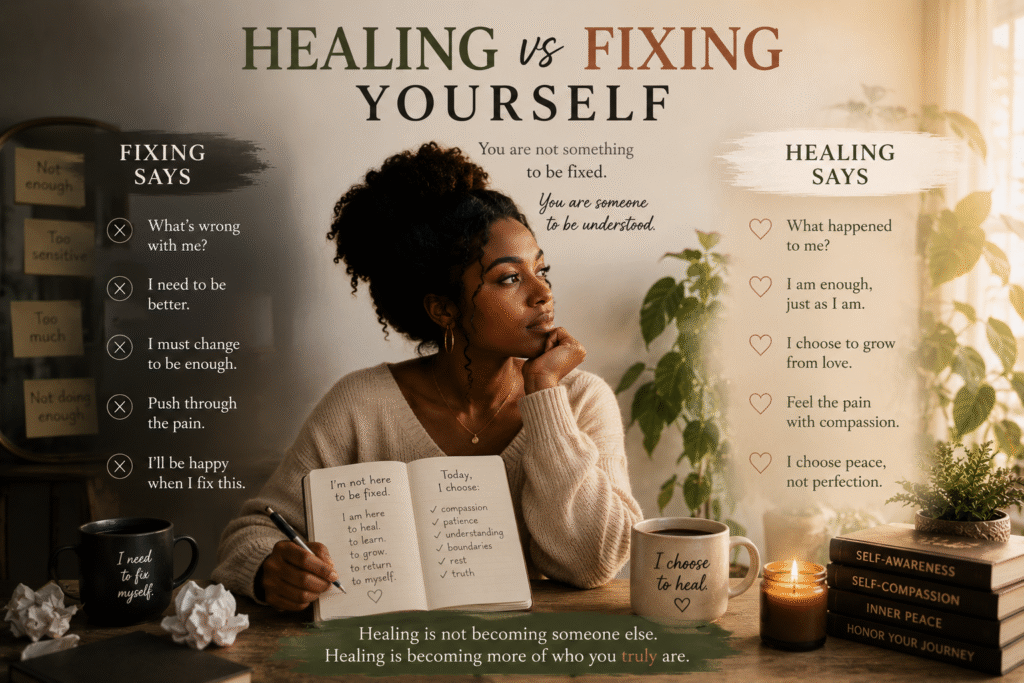
For much of my life, I misunderstood the difference between healing vs fixing yourself. I believed that healing meant correcting everything that seemed wrong with me. I thought I needed to become calmer, more productive, more accepted, more successful, and somehow more worthy. Looking back, I realise I was not trying to heal. I was trying to fix myself. The distinction may seem small, but it changed everything.
The Belief That We Need Fixing
Many of us grow up with the subtle message that something is wrong with us.
Perhaps we are too sensitive.
Too emotional.
Too quiet.
Too loud.
Too creative.
Too different.
At some point, many people begin to see themselves as a collection of flaws that require correction.
The self-help industry often reinforces this belief. We are encouraged to optimise ourselves, improve ourselves, and upgrade ourselves. While growth can be positive, there is a danger when personal development becomes rooted in self-rejection.
When we believe we are fundamentally broken, every attempt at growth becomes an attempt to escape ourselves.
That is not healing.
That is fixing.
Healing Begins With Acceptance
The biggest lesson I have learned about healing vs fixing yourself is that healing begins with acceptance.
Acceptance does not mean giving up.
It does not mean avoiding responsibility.
It does not mean refusing to grow.
Acceptance simply means acknowledging reality without fighting it.
Before we can change anything, we must first be willing to see it clearly.
Many people spend years fighting their emotions.
They fight sadness.
They fight anxiety.
They fight grief.
They fight fear.
The harder they fight, the stronger those emotions often become.
Healing asks a different question.
Instead of asking, “How do I get rid of this?”
Healing asks, “What is this trying to teach me?”
That shift creates space for understanding.
Fixing Yourself Is Often Driven by Shame
When I look back on periods of my life where I was obsessed with self-improvement, I can see that much of it was driven by shame.
I did not believe I was enough.
I believed I needed to become someone else before I could be happy.
Many people live with this belief.
They tell themselves:
“I’ll be happy when I lose weight.”
“I’ll be happy when I make more money.”
“I’ll be happy when people approve of me.”
“I’ll be happy when I finally fix myself.”
The problem is that the finish line keeps moving.
There is always another flaw to correct.
Another problem to solve.
Another reason not to feel worthy.
Healing interrupts this cycle.
Healing says:
“You are worthy now.”
Not perfect.
Not finished.
Not complete.
But worthy.
The Difference Between Growth and Self-Rejection
One of the reasons the conversation around healing vs fixing yourself can be confusing is because both involve change.
Healing creates change.
Growth creates change.
Transformation creates change.
The difference lies in the motivation.
When change comes from self-rejection, it often feels exhausting.
When change comes from self-respect, it feels different.
Imagine two people deciding to improve their health.
One says:
“I hate my body. I need to fix it.”
The other says:
“I care about my body. I want to support it.”
The action may look similar.
The energy behind it is completely different.
One is driven by shame.
The other is driven by care.
Healing grows from care.
Why So Many People Feel Exhausted
Many people are tired because they are constantly trying to become someone else.
They are maintaining an image.
Performing an identity.
Meeting expectations that do not belong to them.
Trying to fix every part of themselves that does not fit comfortably into society.
This is exhausting work.
The more disconnected we become from ourselves, the more energy it takes to maintain the performance.
Healing often feels like a relief because it allows us to stop pretending.
It allows us to stop fighting ourselves.
It allows us to stop carrying the impossible burden of perfection.
Listening Instead of Correcting
Another important lesson in understanding healing vs fixing yourself is learning to listen.
When we adopt a fixing mindset, every uncomfortable experience becomes a problem.
Every emotion becomes an inconvenience.
Every struggle becomes evidence that something is wrong.
Healing approaches these experiences differently.
Instead of correcting immediately, healing listens.
What is this anxiety trying to tell me?
What is this sadness asking me to acknowledge?
What is this frustration revealing?
Sometimes the emotion itself is not the problem.
Sometimes it is a messenger.
When we learn to listen, we often discover that the very thing we were trying to eliminate contains valuable information.
The Role of Self-Compassion
Healing is impossible without compassion.
Imagine speaking to a friend who is struggling.
You would likely offer patience.
Understanding.
Encouragement.
You would not constantly remind them of their flaws.
Yet many people speak to themselves in ways they would never speak to another human being.
Self-compassion is not weakness.
It is strength.
It creates the emotional safety needed for genuine growth.
Without compassion, change becomes punishment.
With compassion, change becomes an act of care.
Healing Is a Return to Yourself
For years I believed healing was a journey towards becoming someone new.
Now I see it differently.
Healing is often a return.
A return to your values.
A return to your truth.
A return to your creativity.
A return to the parts of yourself that were buried beneath fear, shame, and expectation.
This is perhaps the most important insight about healing vs fixing yourself.
Healing does not require you to become someone else.
Healing invites you to become more fully yourself.
The person you are searching for may not be waiting somewhere in the future.
They may already exist beneath everything you have been carrying.
What Healing Really Means
Today, if someone asked me what healing means, I would not describe it as fixing.
I would describe it as understanding.
Accepting.
Listening.
Learning.
Growing.
Healing is not about becoming perfect.
It is not about eliminating every flaw.
It is not about creating a version of yourself that is finally worthy of love.
Healing is recognising that your worth was never dependent on perfection in the first place.
The conversation around healing vs fixing yourself ultimately comes down to one simple question:
Are you trying to become someone else, or are you learning how to be yourself?
One path leads to endless striving.
The other leads home.
And in my experience, that is where true healing begins.
