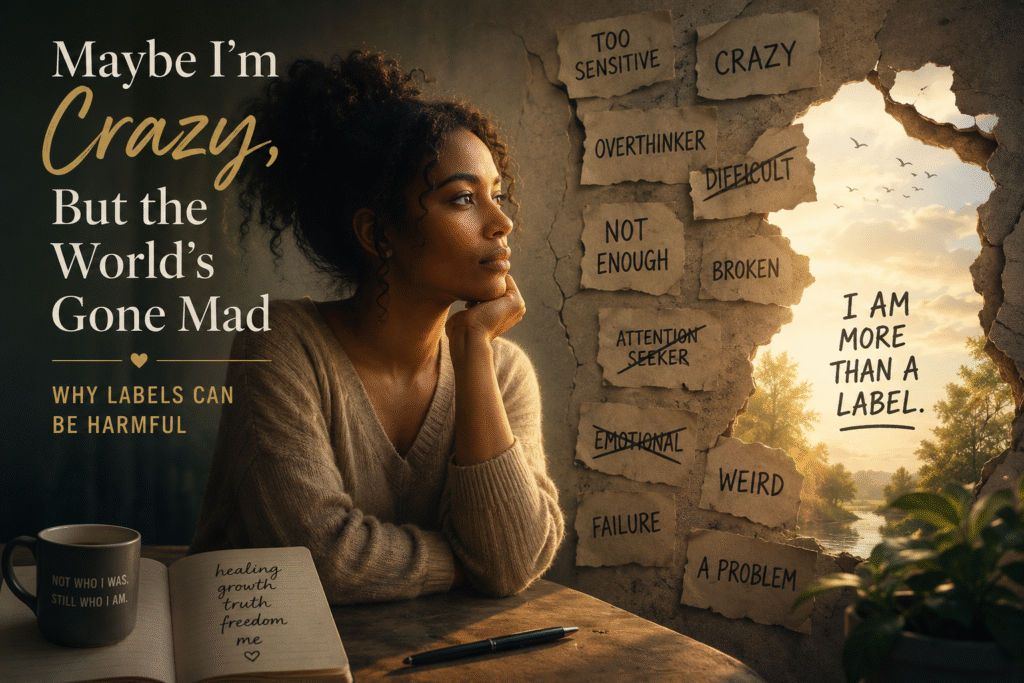
The title of my book, Maybe I’m Crazy, But the World’s Gone Mad, often makes people smile. Some laugh. Some pause. Others immediately understand exactly what I mean.
The truth is, the title was born from a question that followed me for many years.
What if the problem isn’t always the individual? The question led me to explore why labels can be harmful, especially when they become more powerful than the person they were meant to describe.
What if some of the distress we experience is not simply a result of something being wrong with us, but a natural response to living in a world that often feels disconnected, overwhelming, and confusing?
This question led me to reflect deeply on the labels we place upon ourselves and others. While labels can sometimes be useful, they can also become prisons. They can limit how we see ourselves, how others see us, and what we believe is possible.
The deeper I looked, the more I realised why labels can be harmful: they often encourage us to see people as categories rather than unique human beings.
The Human Need to Categorise
Human beings naturally categorise things.
We organise books into genres. We organise food into groups. We organise information into categories because it helps us make sense of a complex world.
The problem begins when we apply the same approach to people.
A person becomes “anxiety.”
A person becomes “depression.”
A person becomes “bipolar.”
A person becomes “a failure.”
A person becomes “gifted.”
A person becomes “successful.”
A person becomes “lazy.”
A person becomes “difficult.”
Suddenly, a living, breathing, evolving human being is reduced to a single word.
The label may have started as a description, but over time it becomes an identity.
When that happens, we stop seeing the person.
We only see the label.
Understanding why labels can be harmful starts with recognising that every human being is far more complex than any label could ever express.
When Labels Can Be Harmful Stories
The real power of labels is not in the word itself.
The power lies in the story that follows.
Imagine someone being told repeatedly that they are anxious.
At first, it may simply describe a collection of experiences.
But over time the label can become:
“I am an anxious person.”
Then:
“I have always been anxious.”
Then:
“I will always be anxious.”
The label moves from describing a temporary experience to defining an entire identity.
The same thing happens with countless other labels.
The more we repeat a story, the more real it begins to feel.
Eventually we stop questioning it.
We stop asking whether the label still serves us.
We stop asking whether there is more to us than the description.
The label becomes the lens through which we interpret our entire life.
Understanding why labels can be harmful begins with recognising that a single word should never define an entire human life.
The Labels We Give Ourselves
Not all labels come from professionals or institutions.
Some of the most powerful labels are the ones we give ourselves.
Perhaps at some point in life you decided:
“I’m not creative.”
“I’m not attractive.”
“I’m not intelligent.”
“I’m bad with money.”
“I’m not good enough.”
You may not even remember when the decision was made.
Perhaps it happened after a difficult experience.
Perhaps someone else’s opinion became your own.
Perhaps it was repeated so often that it felt true.
Years later, the label remains.
Not because it is accurate, but because it has gone unquestioned.
This is often why labels can be harmful, because the stories we attach to them can quietly shape how we see ourselves for years.
One of the most liberating moments in life can be realising that many of the labels we carry are simply inherited stories.
They are not facts.
They are interpretations.
And interpretations can change.
My Own Experience With Labels
There have been periods in my life when labels felt heavier than the person carrying them.
There were moments when other people seemed more interested in defining me than understanding me.
At times I accepted those definitions.
I tried to understand myself through the eyes of systems, institutions, and opinions.
The result was confusion.
The more I focused on the labels, the further away I felt from myself.
Eventually I realised something important.
A label may describe part of an experience, but it can never fully describe a person.
It was through my own experiences that I began to understand why labels can be harmful, because the more I focused on the label, the further I seemed to drift from myself.
A diagnosis cannot capture a soul.
A category cannot capture a life.
A file cannot capture a human being.
The moment I began separating myself from the labels placed upon me was the moment I started reconnecting with who I actually was.
The Danger of Over-Identification
The danger is not necessarily the label itself.
The danger is over-identification.
When we become completely identified with a label, we stop allowing ourselves to grow.
If I believe I am permanently broken, why would I expect healing?
If I believe I am incapable, why would I try?
If I believe I am defined by my worst moments, why would I imagine a better future?
Labels become self-fulfilling prophecies.
Not because they are true, but because they influence how we think, behave, and interpret reality.
This is why self-awareness matters.
It allows us to step back and ask:
“Is this label helping me?”
Or:
“Has this label become a limitation?”
There Is More to You Than Your Struggles
One of the greatest mistakes modern culture makes is reducing people to their challenges.
A person experiencing anxiety is still a friend, parent, artist, dreamer, creator, lover, and human being.
A person experiencing depression still contains hopes, talents, memories, strengths, and possibilities.
A difficult season is not an identity.
A painful chapter is not the entire book.
We are far more complex than any single description.
The challenge is remembering that when life becomes difficult.
Why So Many People Feel Lost
I believe many people feel lost because they have become disconnected from their authentic selves.
They are living according to labels, expectations, and roles rather than values.
They spend years becoming who they think they should be.
Eventually they wake up wondering why they feel empty.
The answer is often surprisingly simple.
They have spent so long performing an identity that they have forgotten who they are underneath it.
Healing begins when we become curious again.
Not curious about who society says we are.
Curious about who we actually are.
What Healing Really Means
For a long time I believed healing meant becoming someone else.
I thought healing meant fixing every flaw.
Improving every weakness.
Eliminating every uncomfortable feeling.
Now I see healing differently.
Healing is not becoming someone else.
Healing is becoming more fully yourself.
It is peeling away the layers of fear, shame, conditioning, and expectation that have accumulated over the years.
It is learning to listen to your own voice beneath the noise.
It is remembering that your value does not depend upon a label.
Healing is not perfection.
Healing is authenticity.
Beyond the Label
The invitation is not to reject every label.
Some labels can be useful.
Some provide understanding.
Some provide support.
The key is remembering that the label is not the person.
A map is not the territory.
A description is not the reality.
A diagnosis is not a destiny.
You are not a category.
You are not a file.
You are not a statistic.
You are a living, evolving human being with the capacity to grow, learn, heal, create, and transform.
The moment we remember this, something shifts.
We stop seeing ourselves as problems to be solved.
We begin seeing ourselves as people to be understood.
Maybe the Question Matters More Than the Answer
The title Maybe I’m Crazy, But the World’s Gone Mad was never really a statement.
It was a question.
A challenge.
An invitation to think differently.
What if the problem isn’t always you?
What if some of the discomfort you feel is a signal rather than a defect?
What if some of the labels you’ve been carrying no longer belong to you?
What if healing begins not by becoming someone else, but by remembering who you were before the world told you who you had to be?
These questions may not provide immediate answers.
But sometimes a powerful question can change the direction of an entire life.
And perhaps that is where true healing begins.
Not in a label.
But in the willingness to look beyond one.
